

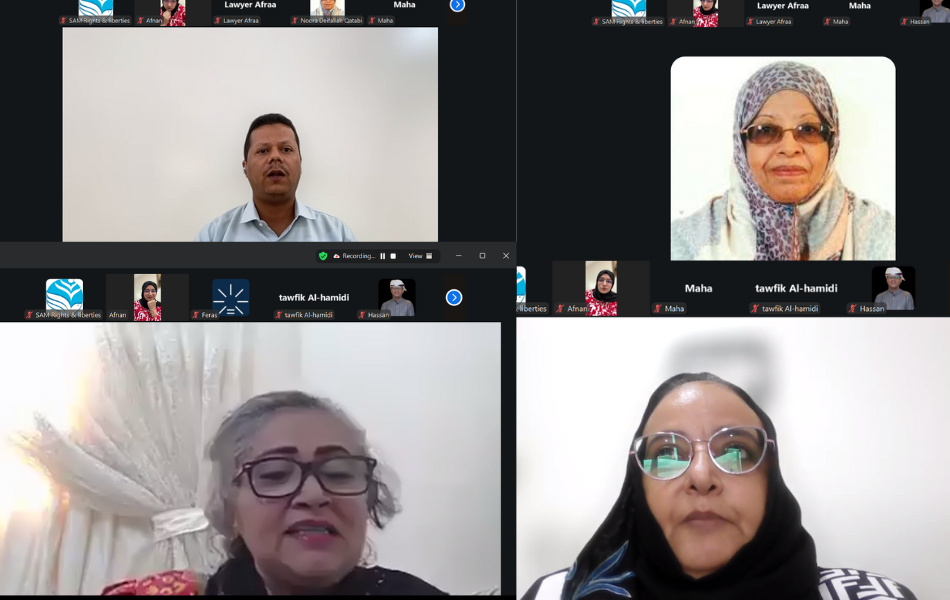
SAM Organization for Rights and Liberties, in partnership with the Abductees’ Mothers Association and the Justice4Yemen Pact Coalition, held an extensive rights-focused webinar titled:
"The Southern–Southern Dialogue Conference in Riyadh: Justice and Rights as a Path to Rebuilding Trust and Achieving Sustainable Resolution"
as part of the SPARK project supported by the DT Institute. This event was organized within the framework of the Transitional Justice Ambassadors Forum and aimed to highlight the human rights dimensions of the Saudi-sponsored Southern Dialogue—a key step toward addressing the historically marginalized and exploited southern issue. The webinar stressed that the stability of southern Yemen is a cornerstone for national and regional stability, particularly in light of recent events in Hadramout, and emphasized the need for a transparent and independent judicial pathway free from political polarization and pressure.
Human Rights as a Common Ground, Identity, and Representation Challenges
Activist Maha Awad, Chair of the Wujud Foundation for Human Security, emphasized that human rights must serve as the common ground for dialogue, not a political tool. She criticized previous agreements, such as the 2019 Riyadh Agreement, for lacking a rights-based approach, prioritizing political settlements over victims’ rights. Awad also raised concerns about identity rights, warning against imposing the term “Southern Arab State” over the historical identity of the former People’s Democratic Republic of Yemen, and stressed the need to include civil society, women, and youth in dialogue processes dominated by armed actors.
Handling Enforced Disappearances and Regional Responsibility
Lawyer Afra Al-Hariri addressed the long-standing issue of enforced disappearances, proposing the creation of a temporary, neutral national body of judges, lawyers, civil society representatives, and victims’ families to identify the fate of the disappeared and hold perpetrators accountable. She highlighted that existing documentation is insufficient without clear accountability measures, noting that parties involved in violations since 2015 still hold high positions of power. Al-Hariri also pointed to political cover-ups of secret detention facilities and stressed that regional actors, including the UAE and Saudi Arabia, share responsibility by being aware of these facilities. She criticized prior national inquiry reports denying the existence of secret prisons and emphasized the need for criminal judicial measures, not politically negotiated settlements.
Lessons from Handling Forced Job Removals
Judge Noura Daifallah Qatbi shared the experience of the Presidential Committee for Addressing Forced Job Removals in Southern Provinces, established by Republican Decree No. 2 of 2013. The committee addressed grievances of over 160,000 civil, military, and security employees dismissed after the 1994 war or due to economic unit privatization, successfully restoring the rights of approximately 62,000 employees and securing YER 4 billion in 2023. Despite its achievements, bureaucratic and political obstacles persist, and the committee was excluded from current Riyadh dialogue discussions despite its centrality to southern grievances.
Transitional Justice as a Comprehensive Path to Dignity and Independence
Legal expert Hassan bin Ubaidallah presented a holistic vision of transitional justice as a political issue linked to power structures, not a secondary humanitarian matter. Ignoring or marginalizing this path perpetuates conflicts and erodes trust. He urged leveraging the Riyadh conference to redefine justice as essential for future stability and as a foundation for a new political contract, proposing practical steps such as incorporating justice into conference outcomes, officially acknowledging violations, issuing apologies to victims, providing material, moral, and symbolic redress, and instituting genuine institutional reforms in security and judicial bodies. He also stressed protecting local community identities in regions like Mahra and Socotra, emphasizing that locally grounded solutions are essential for social acceptance.
Voices from the Field and Victims’ Perspectives
Participants shared field experiences, highlighting atrocities such as live burials of prisoners in Hadramout deserts and airstrikes targeting southern forces, questioning how these violations fit into transitional justice. Ummat Al-Salam Haj, Chair of the Abductees’ Mothers Association, recounted the suffering of mothers in Aden unaware of their children’s whereabouts, calling for an independent investigation free from politicization. Activist Arwa stressed that southern dialogue must include victims and criticized the presence of perpetrators at the Riyadh table. Lawyer Abdullah Said from Socotra emphasized the need for a supportive political environment that enforces principles on the ground rather than relying on current political divisions that hinder field committees.
Strategic Recommendations
The webinar concluded that transitional justice must be inclusive, covering all parties and regions. Participants highlighted the importance of civil society coordination in ensuring rights and justice remain central to political settlements. Recommendations included establishing an independent judicial track, protecting witnesses and victims, ensuring the participation of women and youth in decision-making, and anchoring outcomes in the southern public’s aspirations for dignity and fairness. The forum reaffirmed that Yemen’s and the region’s stability is inseparable from justice and the protection of human rights, free from political manipulation.